Magda Myszkowski: Returning to Poland Through Weaving
4 November 2026
Deicke Richards Associate and Senior Interior Designer Magda Myszkowski has recently returned to the office after a lengthy study trip to her homeland, Poland, to learn more about traditional weaving practices. Magda is an avid weaver and regularly exhibits her work. She reflects on her trip below.
There are places that stay with us, even when we have spent much of our lives somewhere else. For me, Poland, my motherland, is one of those places. I have long felt a pull to return, accompanied by a growing curiosity about its people, landscapes, traditions and cultural heritage.
I migrated to Australia in 1989. This year, after nine years away, I returned to Poland for a study tour that had been two years in the making. This time, the journey was about more than visiting family. It was an opportunity to reconnect with Poland through its makers, rural communities and living traditions, and to explore my cultural heritage through the shared language of making.
Following the thread
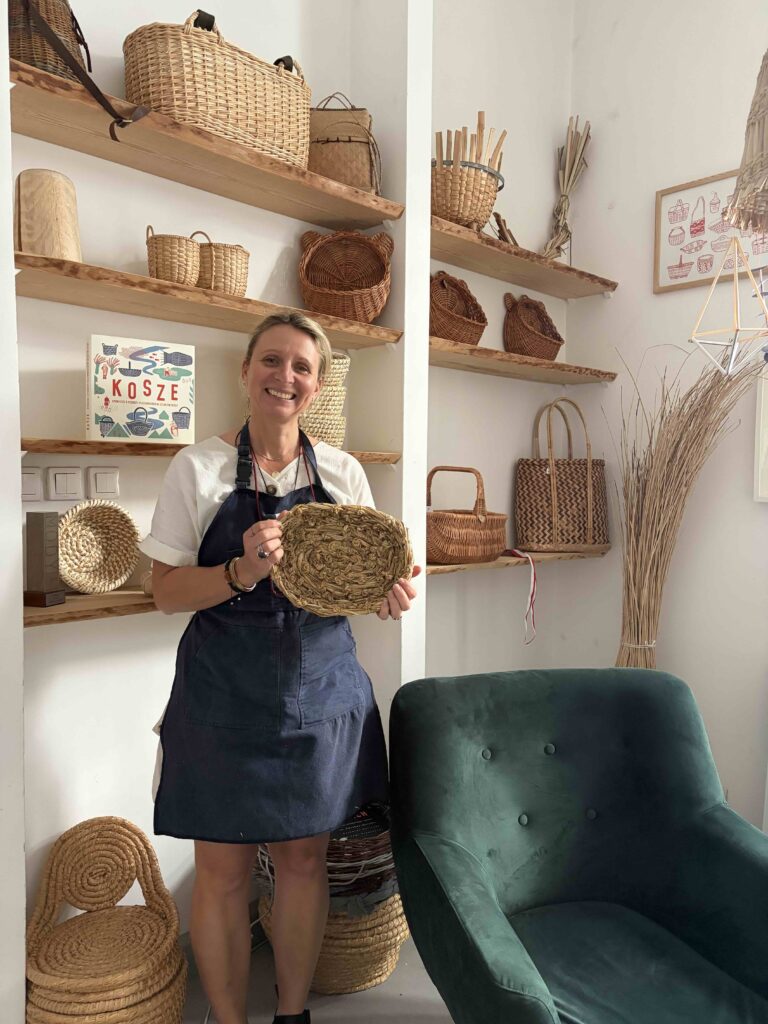
My weaving journey began around ten years ago at a coil-weaving workshop in Nimbin, where I made a tiny basket from local lomandra grasses. Over the years, I explored different materials and techniques before returning to coiling, working primarily with raffia.
As my practice developed, so did my curiosity about the histories behind the techniques I was using. Research into Australian coiled basketry introduced me to the rich and complex traditions of Aboriginal weaving, including the cultural knowledge, connection to Country and intergenerational teaching that sustain these practices. It also prompted me to consider how I might better understand the weaving traditions of my own Polish heritage.
What materials did Polish makers work with? How did their techniques develop in response to the landscape and rural life? And who is keeping these traditions alive today?
Supported by the Regional Arts Development Fund and Redland City Council, and the Polish Consulate in Sydney through my connection with the Polish Ex-Servicemen’s Association in Capalaba, I set out to explore these questions through practical workshops, conversations with makers, museum visits and observation.
Learning from the makers
In Krzeszów, I learned traditional willow basketry from Adam Jaskowski, exploring the preparation of willow and the construction of different basket forms. In Rudnik nad Sanem, Poland’s renowned wickerwork centre, master weaver Ryszard Machowski and his wife, Maria, welcomed me into their world. Ryszard grew up in a family of weavers and shared the story of a tradition that has supported local livelihoods for generations. Under his guidance, I made my own basket from prepared willow.
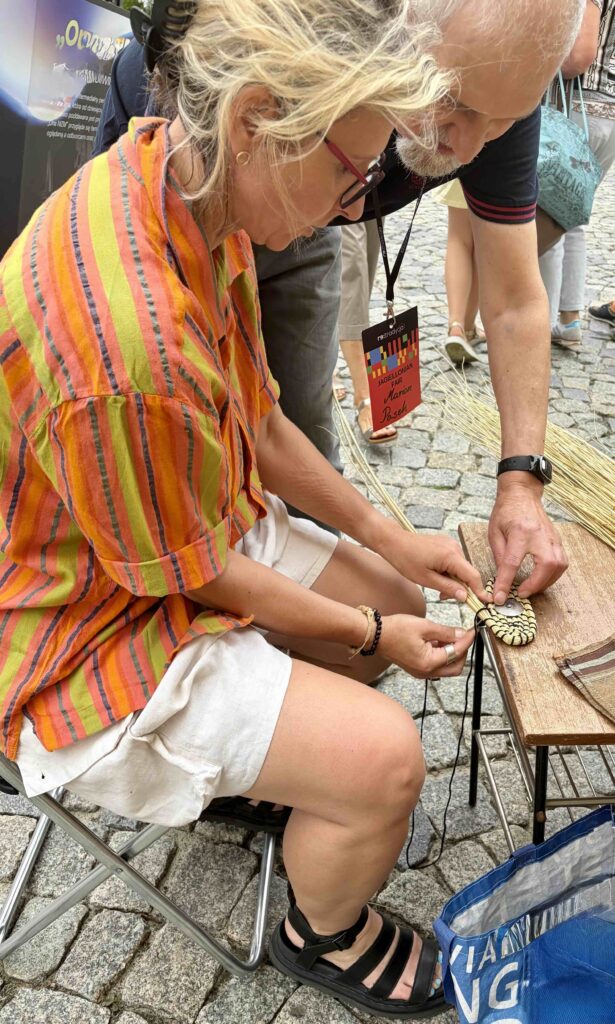
In the Lublin region, I met Marian Pasek, who works with straw and pine roots. His stitched straw baskets immediately caught my attention: the technique closely resembles the coiling I practise in Australia, using bundles of rye or buckwheat straw secured with linen cord. Seeing this shared structural principle, expressed through different materials and cultural contexts, was a particularly meaningful moment.
At the Jarmark Jagielloński folk festival in Lublin, I encountered an extraordinary community of traditional makers. I met Wiesław Chołuj, known for his traditional kabłączok willow baskets made for harvesting potatoes, Grzegorz Gortat, who combines traditional basketry techniques with contemporary design, and fourth-generation wooden toy maker Marian Łoboz.
I also learned from Małgorzata and Tomasz Krajewski, who are reviving and reinterpreting traditional pająki — intricate hanging decorations made from straw and paper. Learning to construct the geometric elements of a pająk krystaliczny showed me how research, hands-on practice and community teaching can bring a traditional craft into the present.
Further experiences took me to Stojeszyn, where I attempted to weave a traditional sun hat using rogożyna (cattail) with local village leader Beata Wójcik, and to Cieszyn, where I joined hands-on workshops with Serfenta, an organisation that documents traditional craft techniques and shares them through contemporary, practice-based learning. There, I explored basket-making with cattail and rye straw, learning tape-cross, looping and coiling techniques. At the World Wicker and Weaving Festival in Nowy Tomyśl, I met artist Adam Pliśko, whose incredible woven work transforms traditional techniques and natural materials sourced from his own property into striking contemporary art. In Łążek Garncarski, a village with a centuries-old pottery tradition, potter Adam Żelazko demonstrated working with local clay and spoke about passing his skills on to the next generation. Visits to open-air ethnographic museums further contextualised these encounters, revealing how traditional crafts are deeply rooted in rural life, regional materials and local customs.
What I brought home
Amongst all of these amazing experiences, I learnt several important lessons.
Craft knowledge is embodied in the hands and decisions of experienced makers, and traditional techniques are inseparable from the landscapes and materials that shape them. Skills survive through relationships, between generations, within families, and through the work of artists, teachers, museums, and community organisations.
Most importantly, living heritage is alive! The makers I met are not simply preserving the past; they are adapting techniques, developing new forms and finding ways to engage contemporary audiences.
Over the coming year, I’ll share what I learned through workshops at the Polish Ex-Servicemen’s Club in Capalaba. These will include making an Easter basket inspired by the Polish święconka tradition of blessing Easter food, and a coiled bread basket using traditional Polish techniques adapted to locally sourced Australian materials.
These workshops will build on the club’s existing Traditional Polish Easter and Christmas craft activities, creating opportunities to share techniques and stories across generations.
The project will also inform an exhibition bringing together artists connected to Polish heritage, whether by birth or by bond, exploring the relationship between cultural heritage, traditional making and contemporary artistic practice.
I returned to Poland with questions about weaving and came home with new skills, meaningful encounters and a deeper appreciation of the knowledge carried by traditional makers.
A woven basket is more than a functional object. It carries traces of the landscape, the materials, the techniques, and the people who keep that knowledge alive.
My hope is to bring those threads together here in Australia; learning from the past, sharing what I have discovered, and creating new opportunities for these traditions to be practised, understood and reimagined.
With thanks to the makers and communities who generously shared their knowledge, and to the Regional Arts Development Fund and Redland City Council and the Polish Consulate in Sydney for supporting this journey